The CY 2027 OPPS Proposed Rule: Surviving the IPO List Exodus with Outpatient CDI
The Centers for Medicare & Medicaid Services (CMS) recently released the Calendar Year (CY) 2027 Hospital Outpatient Prospective Payment System (OPPS) proposed rule on July 2, 2026. While the proposal includes a modest 2.4% increase in OPPS payment rates, the underlying regulatory shifts represent a massive disruption to hospital margins.
Between aggressive site-neutral payment expansions and sweeping changes to the Inpatient-Only (IPO) list, hospitals must fundamentally rethink their Clinical Documentation Improvement (CDI) strategies. In 2027, protecting your revenue will rely entirely on the precision of your outpatient data management.
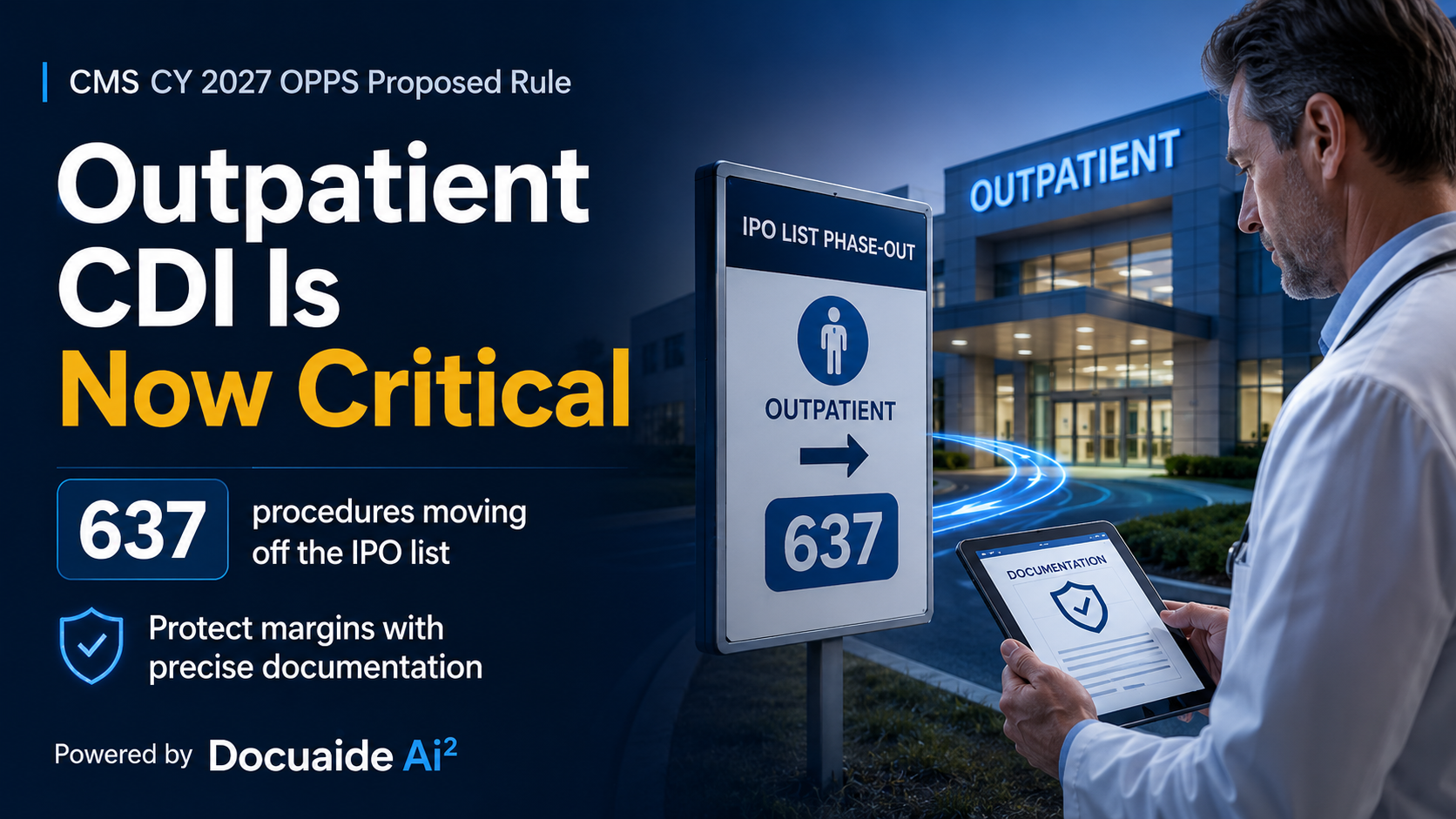
The IPO List Exodus: 637 Procedures Moving to Outpatient The most alarming takeaway from the CY 2027 proposed rule is the continuation of CMS's three-year phase-out of the IPO list. For CY 2027, CMS intends to remove 637 procedures from the IPO list, assigning them instead to clinical ambulatory payment classifications (APCs).
When highly complex procedures—especially those in orthopedics and cardiology—shift from inpatient to outpatient settings, the documentation requirements change drastically. Clinicians must meticulously capture comorbidities, severity of illness (SOI), and risk of mortality (ROM) to justify inpatient admissions when clinically necessary or to secure maximum outpatient reimbursement. Legacy, inpatient-focused CDI programs are simply not equipped to handle this volume of ambulatory scrutiny.
Margin Squeezes: 340B Cuts and Site-Neutral Imaging The margin pressure doesn't stop at the IPO list. The CY 2027 OPPS proposed rule targets two other massive revenue drivers:
- 340B Drug Payments: CMS proposes to slash Medicare payments for 340B-acquired drugs to average sales price (ASP) minus 33.4%. Furthermore, CMS plans to accelerate the 340B remedy budget neutrality adjustment, increasing the annual reduction from 0.5% to 3% effective January 1, 2027.
- Site-Neutral Imaging: CMS is proposing to expand site-neutral payment policies to include imaging services without contrast when performed in excepted off-campus provider-based outpatient departments.
With imaging and pharmacy revenues facing such steep proposed cuts, maximizing reimbursement through perfectly coded, highly specific clinical notes is an operational imperative.
Defending Your Revenue with Doc-U-Aide Ai2 Fighting algorithmic payer denials with manual, retrospective audits is no longer a viable strategy. As procedures migrate to the outpatient space, health systems need a robust Clinical Data Foundation that natively supports concurrent, point-of-care documentation integrity.
This is the core architecture behind Doc-U-Aide Ai2. By unifying documentation workflows, hospitals can ensure that no clinical detail is lost between the inpatient and ambulatory domains. Furthermore, integrating our ambient clinical intelligence tool, Srava, ensures that complex medical necessity criteria are captured accurately by the physician in real time, long before the claim drops.
With Doc-U-Aide Ai2, your organization moves from a reactive audit posture to a proactive, defensible data strategy.
The Bottom Line The CY 2027 OPPS proposed rule makes one thing abundantly clear: outpatient CDI is no longer the future; it is the immediate present. Hospitals that fail to modernize their data management and documentation technologies will face severe financial penalties as the IPO list vanishes.
Prepare your health system for 2027. Contact us today to learn how Saince is transforming CDI and clinical data management for the modern regulatory landscape.