If your health system has an active telehealth program, someone in your organization is sitting on a compliance problem they probably don’t know about yet. It will surface — through a HIPAA audit, a malpractice discovery request, or a state medical board inquiry. The question is whether you find it first or a regulator does.
The problem is not the telehealth itself. The problem is what happens after the session ends.
The Anatomy of the Telehealth Documentation Gap
A typical telehealth workflow at most health systems looks like this: the clinician opens Zoom Health, Teams, or Doximity and conducts the encounter. The platform records the session. The session ends. The recording is saved to the platform’s cloud storage.
And then — nothing. The recording sits there. No connection to the EHR. No clinical note generated from the session. No retention schedule applied. No HIM department visibility.
Meanwhile, the clinician documents the encounter — sometimes. Studies of telehealth encounter documentation rates show that physicians create clinical notes for telehealth visits at a rate 15–25% lower than for equivalent in-person visits. The encounter happened. The clinical decision was made. The prescription was issued. But the documentation may not reflect it.
150+ avg telehealth sessions per week at a mid-size health system
30 days Zoom default recording retention (some tiers)
7–10 yrs HIPAA retention requirement for adult medical records
The Three Specific Risks
Risk 1: HIPAA Retention Violation
Telehealth session recordings that contain PHI — which is essentially all clinical telehealth sessions — are subject to HIPAA’s medical records retention requirements. For adult patients, most states require retention of 7–10 years. For pediatric patients, records may need to be retained until the patient reaches the age of majority plus an additional period.
Zoom’s default retention policy for recorded meetings can be as short as 30 days in some account configurations. If your clinical team is using Zoom Health without explicit retention configuration and your IT team is not managing the recordings, you may have hundreds of telehealth encounters that are past their 30-day expiration — gone, with no way to recover them.
The Discovery Scenario
A patient files a malpractice claim relating to a telehealth encounter from eight months ago. The plaintiff’s attorney issues a discovery request for all records relating to that encounter, including any recordings. If that recording no longer exists because Zoom deleted it at 30 days, and if no other documentation accurately captures the encounter, the organization faces significant liability exposure.
Risk 2: Undocumented Clinical Encounters
A telehealth visit where the physician issued a medication change, ordered a diagnostic test, or made a treatment recommendation without creating a corresponding clinical note is a documentation gap that creates both compliance and clinical risk. For the billing team, it is lost revenue — an encounter with no note cannot be billed. For the CDI team, it is a gap in the severity of illness profile. For the medicolegal team, it is an undocumented clinical decision.
Risk 3: No HIM Governance
Most HIM departments have no visibility into the volume, content, or retention status of their organization’s telehealth recordings. If your medical records team cannot produce a telehealth recording in response to a legal request, they need to know that the recording either exists (and where) or does not exist (and why). Right now, most cannot answer that question.
The Solution Architecture
Solving the telehealth documentation problem requires three capabilities working together:
1. Automated Ingestion from Telehealth Platforms
The platform needs to pull recordings automatically from your telehealth provider — not rely on clinicians or staff to manually upload them. Native API integrations with Zoom Health, Microsoft Teams Health, Doximity, and Teladoc are essential. The recording goes from the telehealth platform to your clinical document processing platform without any human action required.
2. Transcript and Clinical Note Generation
Every recording gets processed into a speaker-diarized transcript — identifying which speaker is the clinician and which is the patient. Natural language processing extracts diagnosis mentions, medication changes, follow-up instructions, and referrals. A draft SOAP note is generated from this content.
This draft note is then sent to the provider for review through their existing EHR workflow. The review and approval takes approximately 90 seconds to 2 minutes — far less than writing the note from scratch.
3. Retention-Compliant Filing
The recording, the transcript, and the approved note are all filed to the patient’s chart with a retention schedule that matches your organization’s medical records retention policy. HIM now has visibility into the recording, the documentation, and the retention timeline.
The Operational ROI
Beyond compliance, the telehealth documentation workflow generates measurable revenue recovery. Consider a health system with 150 telehealth sessions per week where 20% currently go undocumented:
30 undocumented encounters per week × average professional fee of $120 = $3,600 in unbilled revenue per week
$3,600 × 50 working weeks = $180,000 in annual revenue leakage from incomplete documentation alone
Most organizations recover this revenue within 60 days of implementing automated telehealth documentation
The provider time savings add to this: if a provider spends 8 minutes documenting a telehealth encounter manually, and the AI-generated draft reduces that to 2 minutes, 6 minutes of provider time is recovered per encounter. At 150 sessions per week, that is 15 hours of provider time per week returned to clinical care.
Implementation Considerations
What to Look For in a Telehealth Documentation Platform
Direct API integrations with your specific telehealth platform(s) — manual upload workflows will not be adopted consistently
Speaker diarization that correctly identifies clinician vs. patient speech — critical for note accuracy
HITL validation for low-confidence transcription segments — ambient noise, accents, and medical terminology all affect accuracy
Provider review workflow that surfaces within the existing EHR — not a separate application requiring another login
Configurable retention policies that match your state and organizational requirements
Audit trail showing processing date, AI confidence scores, and human review actions
The Phased Approach
Most organizations benefit from a phased implementation: start with new recordings going forward (prospective), demonstrate the workflow, then assess the retrospective backlog of existing recordings that may need processing for compliance.
The prospective workflow goes live in days. The retrospective review of existing recordings is a project that can be sized and scheduled once the prospective workflow is running smoothly.
Free Pilot Offer
Doc-U-Scribe offers a free Telehealth Documentation Pilot: send us 10 existing recordings from any platform, and we will return speaker-diarized transcripts and draft SOAP notes within 24 hours. No setup required. BAA signed upfront. See the workflow before you commit to anything.
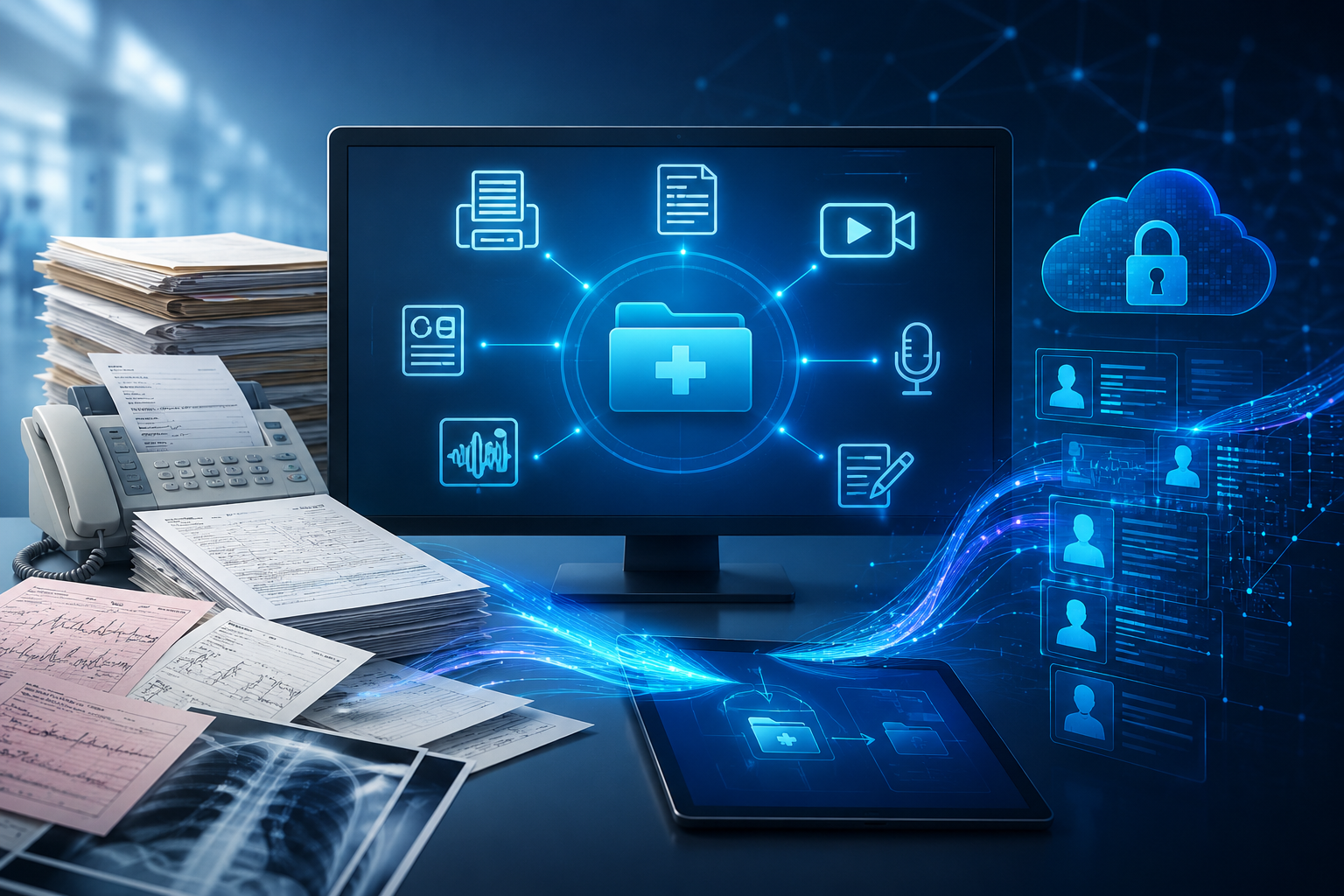
Every HIM Director knows the feeling. You open the queue on Monday morning, and before you can touch the structured work — the coding queries, the CDI reviews, the compliance reports — you have to wade through the pile. The faxes that arrived over the weekend. The telehealth recordings sitting in a Zoom folder someone emailed you about. The handwritten notes from the ICU that were scanned and sent over as image files. The patient intake forms that front desk couldn’t get to on Friday.
This is the pile that gets no respect in healthcare IT conversations. Vendors talk about EHR optimization, clinical decision support, population health analytics. Nobody talks about the pile. But the pile is where your team’s time goes, where burnout starts, and where patient safety risks hide.
The reason the pile exists is structural: EHRs were designed to manage structured, discrete data — lab values, vital signs, medication orders, coded diagnoses. They were not designed to ingest, classify, and extract meaning from the unstructured content that represents 80% of all clinical information a health system generates. That gap is the pile.
This article breaks down each of the eight content types that HIM departments commonly face, the specific processing challenges each one creates, and the approaches that are actually working in production environments today.
Why This Matters More Than Ever
Three trends are converging to make the unstructured data challenge more acute than ever for HIM:
Telehealth expansion has created a new category of unmanaged clinical content: video recordings, audio logs, and session transcripts that exist outside any EHR workflow
Regulatory scrutiny is increasing — HIPAA auditors are specifically asking about telehealth recording retention, and organizations that cannot demonstrate compliant workflows are at risk
Staffing shortages are making manual document processing unsustainable — HIM teams are smaller and facing higher volumes simultaneously
80% of clinical data is unstructured
$300B annual cost of dirty data in US healthcare
70% of medical communications arrive by fax
Content Type 1: Inbound Faxes
The Challenge
Despite everything the healthcare industry has done to modernize clinical communication, approximately 70% of medical information exchange still occurs via fax. A fax arrives as a PDF or TIFF image — a photograph of a document, to be precise — and requires a trained human to read, classify, identify the patient, extract the relevant clinical data, and manually enter that data into the appropriate EHR fields.
For a mid-sized health system processing 200–500 inbound faxes per day, this manual workflow consumes thousands of labor hours per year and is a primary driver of HIM burnout. It also creates clinical risk: a fax misclassified as routine when it contained urgent lab results, or a referral routed to the wrong department because the patient name was ambiguous.
What Actually Works
Intelligent Document Processing (IDP) platforms now achieve 94–97% auto-filing accuracy on clean, printed fax content. The workflow: the fax arrives, AI classifies the document type (referral, lab result, prior auth, prescription refill), extracts the patient demographics and key clinical data, matches to the correct MPI record, and stages the structured data for EHR routing — all in seconds.
The important caveat: AI accuracy degrades on faxed-of-faxes (third-generation copies), handwritten content within faxes, and unusual document formats. A Human-in-the-Loop (HITL) validation step — where a trained specialist reviews low-confidence extractions — is essential for maintaining the accuracy levels that clinical documentation requires.
Key Metric
Teams implementing automated fax processing reduce manual fax handling time by 60–70% on average, with the remaining staff time redirected to higher-value CDI and coding work.
Content Type 2: Scanned Documents
The Challenge
Scanned documents are the legacy problem that never went away. Decades of paper records, converted to PDF or TIFF through departmental scanners, live in document management systems as what HIM professionals call ‘dumb images’ — files that an EHR can store but cannot search, cannot index by clinical concept, and cannot use to trigger decision support.
A scanned operative report, for example, contains the surgeon’s technique, the implant specifications, the post-operative instructions, and the anesthesia record. All of that clinical information is invisible to any analytics tool unless a human re-keys it into structured fields.
What Actually Works
Modern OCR (Optical Character Recognition) combined with Natural Language Understanding (NLU) can extract and structure the clinical content from most clean scanned documents with high accuracy. The resulting output — tagged clinical entities, ICD-10 and CPT code suggestions, extracted patient demographics — can be attached to the document and indexed in the EHR, making decades of scanned content searchable by concept for the first time.
The practical limitation remains handwritten content within scanned documents, which requires a different approach covered in Content Type 5 below.
Content Type 3: Telehealth Session Recordings
The Challenge
Telehealth exploded during the pandemic and has stabilized at a level that has fundamentally changed clinical documentation requirements. Most health systems now have hundreds of telehealth sessions per week — many of which are being recorded by the telehealth platform (Zoom Health, Microsoft Teams, Doximity, Teladoc) and stored in a cloud folder that HIM has no visibility into, no retention control over, and no connection to the EHR.
This creates three simultaneous problems. First, a HIPAA compliance risk: telehealth recordings containing PHI must be retained under the same medical records retention standards as any other clinical documentation. Second, a revenue cycle risk: physicians are creating clinical notes for telehealth visits at lower rates than in-person visits, leaving encounters undocumented and unbilled. Third, a medicolegal risk: if a patient’s telehealth session recording is subpoenaed and the organization cannot produce it because Zoom deleted it after 30 days, that is a significant liability.
What Actually Works
Platforms that can ingest recordings directly from telehealth providers (via API integration with Zoom, Teams, Doximity) and automatically produce structured clinical output are the only scalable solution. The processing pipeline: audio extraction from the video file, speaker-diarized transcription identifying which speaker is the clinician and which is the patient, natural language processing to extract diagnoses and medication mentions, and generation of a draft SOAP note for provider review.
The provider reviews the AI-generated note in under two minutes, corrects any errors, and signs it. The recording is then filed with the encounter, the note is filed in the EHR, and the billing record is complete. Total provider burden per telehealth encounter: approximately 2 minutes additional time for documentation review.
Compliance Note
HIPAA requires telehealth recordings containing PHI to be retained under the same standards as other medical records — typically 7–10 years for adult patients. Organizations should audit their current telehealth recording storage and retention practices before their next HIPAA review.
Content Type 4: Clinical Video Files
The Challenge
Beyond telehealth, health systems generate a significant volume of clinical video content that belongs in the medical record: surgical procedure recordings, endoscopy videos, wound documentation photographs and videos, radiology-adjacent imaging, and clinical training recordings that reference specific patient cases. These files typically live on surgical system hard drives, camera memory cards, or departmental shared drives — disconnected from the EHR and from any structured clinical workflow.
What Actually Works
For procedural video, the primary value of AI processing is in the audio track: surgeon narration of technique, anesthesia record verbalized during the procedure, nursing documentation spoken aloud. Speaker-diarized transcription of this audio, combined with procedure code extraction, provides a structured clinical record that can be attached to the surgical encounter.
The video file itself — after audio processing — can be stored in a HIPAA-compliant clinical media repository with EHR linking, making it retrievable for quality review, surgical outcome tracking, and medicolegal purposes.
Content Type 5: Handwritten Physician Notes
The Challenge
Handwritten notes are the hardest problem in clinical document processing, and any vendor who tells you otherwise is not being honest with you. The variability of individual physician handwriting, combined with the speed at which clinical notes are typically written, produces documents that push the limits of even the most advanced AI recognition systems.
The practical accuracy range for pure AI-only handwriting recognition on real clinical notes from emergency departments and intensive care units is 75–85%, depending on the legibility of the specific physician’s handwriting. At 80% accuracy, one in five words is wrong. In a clinical context, a misread medication dosage or a wrongly transcribed diagnosis code is not an acceptable error.
What Actually Works
The only approach that achieves clinically acceptable accuracy on handwritten notes is a combination of AI and human validation — what is called Human-in-the-Loop (HITL) processing. The AI processes the note first (fast, inexpensive), identifies high-confidence extractions, and flags ambiguous sections. A trained clinical documentation specialist — someone with medical vocabulary training, not a general transcriptionist — reviews and corrects the flagged sections before the output routes to the EHR.
This hybrid approach achieves 99%+ validated accuracy because the human expert only reviews the sections where the AI is uncertain — typically 20–30% of the text — rather than transcribing the entire note from scratch. It is faster than pure manual transcription and more accurate than pure AI.
Industry HonestyAlways ask AI vendors for their accuracy benchmarks specifically on handwritten clinical notes — not on printed documents, not on clean dictation. Benchmark tests on handwritten ED and ICU notes from actual clinical environments consistently show accuracy 10–20 percentage points lower than vendors advertise for clean content.
Content Type 6: Patient Paper Forms
The Challenge
Despite the proliferation of patient portal self-service tools, a significant percentage of patient-facing documentation still arrives on paper: intake questionnaires, health history forms, consent documents, release of information requests, and HIPAA acknowledgments. Each of these forms contains structured data fields — patient demographics, chief complaints, medication lists, insurance information — that must be manually re-entered into the EHR.
For a practice seeing 50 patients per day, manual form processing can consume 2–3 hours of front desk time — time that could be spent on patient interaction, scheduling, and care coordination.
What Actually Works
Template-aware extraction — where the processing system knows the structure of your specific forms — achieves 92–97% accuracy on printed patient forms. The system recognizes each form type, maps the handwritten or printed entries to the corresponding EHR fields, matches the patient to the Master Patient Index (MPI), and stages the structured data for one-click acceptance by a staff member.
The key differentiation from generic OCR is the template-awareness: the system needs to be configured with your specific form designs to achieve high accuracy. This configuration typically takes days, not months, and can accommodate hundreds of different form templates.
Content Type 7: Voice and Audio Files
The Challenge
Physician dictation has historically been the core use case for medical transcription — and remains a significant volume workflow for many health systems. Beyond structured dictation, audio files in clinical settings include bedside recording devices, voicemail messages with clinical instructions, audio from patient home monitoring devices, and podcast-format provider communications.
Modern ambient AI (Dragon Medical, Nuance DAX) has significantly automated the structured dictation workflow. However, these tools are optimized for in-EHR, real-time use by the dictating physician. They do not process audio files that arrive after the clinical encounter, audio from devices outside the EHR environment, or audio from non-physician clinical staff.
What Actually Works
AI transcription of audio files using models trained on medical vocabulary achieves 88–96% accuracy on clearly-recorded physician dictation. Combined with ICD-10 and CPT code suggestions from the transcript, this produces a structured clinical note that requires only provider review and signature.
For audio with background noise, multiple overlapping speakers, or non-standard clinical vocabulary, the HITL layer is again essential for achieving acceptable accuracy.
Content Type 8: PDF and Word Files
The Challenge
External clinical documents — referral packets, specialist consult letters, hospital discharge summaries, external lab results — frequently arrive as PDF or Word files. Unlike faxed documents, these files contain selectable text that can be extracted without OCR. However, that text is typically unstructured narrative that requires NLP to extract the discrete clinical data elements of interest.
What Actually Works
Full-text extraction combined with clinical NLP entity recognition can classify these documents, identify the key clinical concepts (diagnoses, medications, procedures, follow-up instructions), and tag the document with structured metadata that makes it searchable within the EHR. The document itself is filed to the patient chart; the structured entities are available to CDI and analytics tools.
The Integration Reality
All eight of these content types ultimately need to connect to your EHR. The integration landscape has two primary standards:
HL7 v2 ORU messages for high-volume, reliable document routing — the standard that labs and radiology have used for decades and that every major EHR supports
FHIR DocumentReference for modern EHR connectivity, allowing the source document (the original fax, the original recording) to be linked to the patient chart alongside the structured extracted data
The practical reality: do not let any vendor promise ‘seamless auto-writing’ of structured data directly into the active medical record. Epic and Cerner specifically restrict direct third-party writes to the legal medical record for liability reasons. The correct integration model is Data Staging — structured data is proposed to the EHR, and a clinician or HIM specialist reviews and accepts it. This creates a liability shield (the human remains responsible for the data) while eliminating the tedious manual entry work.
Where to Start
The practical recommendation for any HIM department beginning this journey: don’t try to solve all eight content types at once. Identify the one or two that are causing the most operational pain and the most burnout risk, run a structured pilot on those, demonstrate ROI, and expand.
For most departments, the answer is fax automation — the volume is highest, the ROI is most visible, and the setup is typically fastest (48–72 hours to connect to an existing fax number). Telehealth documentation is the second most common urgent need, driven by compliance concern.
The goal is not to replace your HIM team. The goal is to redirect their expertise — from manual data entry to data quality validation, from document indexing to CDI querying, from printing faxes to clinical content governance. That transition, done well, improves both staff retention and departmental value.
About Doc-U-Scribe
Doc-U-Scribe is the Intelligent Clinical Data Foundation — a single platform that handles all eight clinical content types with Human-in-the-Loop validation built into every workflow. We offer free pilots for each content type. Contact us at docuscribe.com to schedule a demonstration with your actual document types.
For many health systems, the path to innovation is blocked by the ghosts of software past. As organizations grow through acquisitions or transition to modern EHRs like Epic or Cerner, they often leave behind a trail of “zombie” legacy systems. These are old databases and archives kept on “life support” simply because they contain historical patient records that might be needed for a legal request or a rare clinical look-back.
This isn’t just an IT nuisance; it is Legacy Debt, and the interest rates are staggering.
How Legacy Silos Hurt the Enterprise
Maintaining a fragmented landscape of old applications is a multi-front assault on your organization:
The Talent Drain (People Costs): Your high-value IT talent shouldn’t be spent maintaining servers for a 15-year-old software version that only three people know how to use. The labor cost of patching, securing, and supporting “zombie” systems is a massive, non-productive spend.
The “Data Scavenger Hunt” (Patient Care): When a clinician needs a patient’s historical oncology report or a specific lab trend from a previous provider, they shouldn’t have to log into three different portals. Delays in data retrieval lead to incomplete clinical context, redundant testing, and slower care delivery.
Security & Compliance Risk: Legacy systems are the “soft underbelly” of healthcare cybersecurity. They often lack modern encryption and are no longer patched by vendors, making them prime targets for ransomware that can paralyze an entire network.
The Saince Solution: Building the Unified Nexus
Saince One allows you to decommission the past to power the future. Through our Clinical Data Foundation, we provide a secure, Vendor Neutral Archive (VNA) that centralizes all historical, unstructured, and legacy data into a single, searchable repository.
Instead of paying multiple maintenance fees, you consolidate your data into the Saince Fabric Core. This doesn’t just save money; it creates a clean, high-fidelity data asset. By unifying your silos, you provide clinicians with a “single pane of glass” view of the patient’s entire history and ensure your organization is AI-ready. You cannot train a predictive model on data you can’t reach; Saince One makes that data accessible, actionable, and secure.
In today’s fast-paced healthcare environment, physicians are constantly juggling numerous responsibilities, from patient consultations to paperwork and administrative tasks. This heavy workload often leaves physicians with limited time for what truly matters – providing quality patient care. Enter medical scribing services, a valuable solution that has revolutionized the healthcare landscape in the United States. In this blog, we’ll explore how medical scribing services are improving patient care and boosting physician satisfaction.
Streamlining Documentation: One of the primary roles of medical scribes is to assist physicians in documenting patient encounters. By taking care of this time-consuming task, scribes free up physicians to focus on their patients. This streamlined documentation process ensures that medical records are accurate, complete, and up-to-date, enhancing patient care by providing a comprehensive view of the patient’s medical history.
Improved Efficiency: Medical scribes are trained to efficiently navigate electronic health records (EHR) systems. This proficiency results in quicker access to patient information, quicker note-taking, and faster turnaround times for lab orders and prescriptions. This increased efficiency translates into shorter wait times for patients and more focused, timely care.
Enhanced Patient-Physician Interaction: With medical scribes handling documentation, physicians can devote more attention to their patients. They can engage in meaningful conversations, actively listen to patient concerns, and develop personalized care plans. This improved patient-physician interaction not only fosters trust but also allows for a better understanding of patient needs.
Reduction in Physician Burnout: The administrative burden in healthcare has contributed to high levels of physician burnout. Medical scribing services alleviate this burden by reducing the time spent on paperwork. Physicians can leave work with a sense of accomplishment, leading to increased job satisfaction and reduced burnout rates.
More Accurate Billing and Coding: Scribes ensure that documentation accurately reflects the care provided, leading to improved billing and coding accuracy. This can result in fewer claim denials, reduced financial stress on healthcare organizations, and better reimbursement rates, ultimately benefiting patients by preserving the viability of healthcare facilities.
Rapid Charting and Consultation Notes: In fast-paced emergency departments and busy clinics, timely charting is crucial. Medical scribes can rapidly document notes during consultations, ensuring that critical information is readily available for follow-up care or referrals.
Comprehensive Clinical Support: Medical scribes are trained in medical terminology and protocols, making them valuable clinical support members. They can assist with gathering patient histories, ordering tests, and facilitating communication between healthcare providers, further enhancing the quality of patient care.
Adaptability to Various Specialties: Medical scribing services are adaptable and can cater to the needs of various medical specialties, from primary care to specialized fields like surgery, cardiology, and emergency medicine. This versatility ensures that patients across the healthcare spectrum benefit from improved care and physician satisfaction.
In the U.S. healthcare system, medical scribing services have emerged as a powerful tool for enhancing patient care and physician satisfaction. By delegating time-consuming administrative tasks to scribes, physicians can refocus on their core mission: delivering high-quality healthcare. The result is a win-win situation – improved patient outcomes and happier, more fulfilled healthcare professionals. As the healthcare landscape continues to evolve, medical scribing services are poised to play an even more significant role in shaping the future of healthcare delivery.
Hire a medical scribe from Saince so that you can improve your patients’ satisfaction and reduce physician stress!
Are you seeking innovative solutions to streamline your healthcare practice’s documentation process? Look no further! We are excited to introduce our cutting-edge medical scribing services, designed to revolutionize the way healthcare professionals manage patient records.
🖊️ What is medical scribing? Medical Scribing is a game-changing service that pairs highly skilled medical professionals with advanced technological tools to optimize the documentation workflow. By working alongside physicians and healthcare providers, our expert scribes ensure accurate and comprehensive capturing of patient encounters, freeing up valuable time for doctors to focus on what they do best—delivering exceptional patient care.
🚀 Advantages of medical scribing: 1️⃣ Enhanced Efficiency: With our dedicated team of trained medical scribes, your practice can experience a significant reduction in administrative burden. By efficiently transcribing medical histories, examinations, diagnoses, and treatment plans in real-time, we empower healthcare professionals to spend more time interacting with patients and providing personalized care.
2️⃣ Improved Accuracy: Our meticulous scribes are extensively trained in medical terminology and documentation standards, guaranteeing accurate and error-free medical records. This ensures seamless communication and collaboration among healthcare providers, ultimately leading to enhanced patient safety and quality of care.
3️⃣ Cost Savings: By outsourcing your medical documentation needs to our specialized team, you can eliminate the overhead costs associated with hiring and training in-house staff. Our flexible service options allow you to scale up or down based on your practice’s requirements, providing a cost-effective solution tailored to your unique needs.
4️⃣ EHR Expertise: Our scribes are proficient in navigating various Electronic Health Record (EHR) systems, ensuring seamless integration of patient data into your existing infrastructure. This expertise minimizes disruptions and maximizes the benefits of digital health solutions, enabling efficient data management and improved patient outcomes.
🤝 Partner with Us: At Saince, we take pride in delivering exceptional medical scribing services that empower healthcare providers to optimize their practice operations. With our commitment to accuracy, efficiency, and cost-effectiveness, we are ready to become your trusted partner in revolutionizing your documentation process.
💬 Contact us today to schedule a personalized consultation and explore how our medical scribing Services can transform your practice. Together, let’s elevate healthcare documentation to new heights!
As the demand for healthcare services continues to grow, the need for efficient and effective patient care is more important than ever. Healthcare providers are constantly looking for ways to improve their productivity and efficiency while ensuring high-quality care for their patients. One of the most effective solutions to this problem is the use of medical scribe services.
Medical scribes are trained professionals who work alongside healthcare providers, primarily doctors and nurse practitioners, to assist with documentation and administrative tasks. This allows healthcare providers to focus on patient care, without the burden of having to spend hours documenting patient information.
The importance of medical scribe services cannot be overstated. Here are some of the key reasons why medical scribes are vital to the healthcare industry:
Improved Productivity
One of the biggest advantages of having a medical scribe is that it allows healthcare providers to work more efficiently. Medical scribes take on many of the administrative tasks that can consume a significant amount of time, such as documenting patient history, physical exam findings, and treatment plans. This frees up healthcare providers to spend more time with their patients, allowing them to provide more thorough and personalized care.
Accurate Documentation
Accurate documentation is essential in healthcare. Medical scribes are trained to accurately document patient information, which can help reduce the risk of errors in medical records. This can help prevent medical errors, reduce liability risks, and improve patient outcomes. In addition, accurate documentation also facilitates better communication between healthcare providers, allowing for more effective collaboration and care coordination.
Increased Patient Satisfaction
When healthcare providers have more time to focus on patient care, it often leads to increased patient satisfaction. Patients feel more heard and cared for when their healthcare provider is able to spend time with them and answer their questions. Medical scribes help to facilitate this by taking on administrative tasks, freeing up healthcare providers to spend more time with their patients.
Cost Savings
Medical scribes can also help reduce costs in healthcare. By improving efficiency and productivity, healthcare providers can see more patients in less time. This can lead to increased revenue for healthcare organizations. In addition, medical scribes can help reduce the risk of errors and liability, which can result in significant cost savings for healthcare organizations.
Improved Quality of Care
Ultimately, the use of medical scribe services can lead to a significant improvement in the quality of care provided to patients. By allowing healthcare providers to focus on patient care and improving documentation accuracy, medical scribes can help prevent medical errors and improve patient outcomes. This can lead to better patient experiences and outcomes, as well as improved satisfaction for healthcare providers.
In conclusion, medical scribe services are a vital component of modern healthcare. They help to improve productivity and efficiency, increase accuracy in documentation, reduce costs, and ultimately improve the quality of care provided to patients. Healthcare providers who incorporate medical scribes into their workflow will be better equipped to meet the growing demand for healthcare services while maintaining high standards of care.
Saince provides experienced and skilled Medical Scribes to your facility so that you can significantly increase your patient satisfaction, improve revenues and reduce physician burnout.