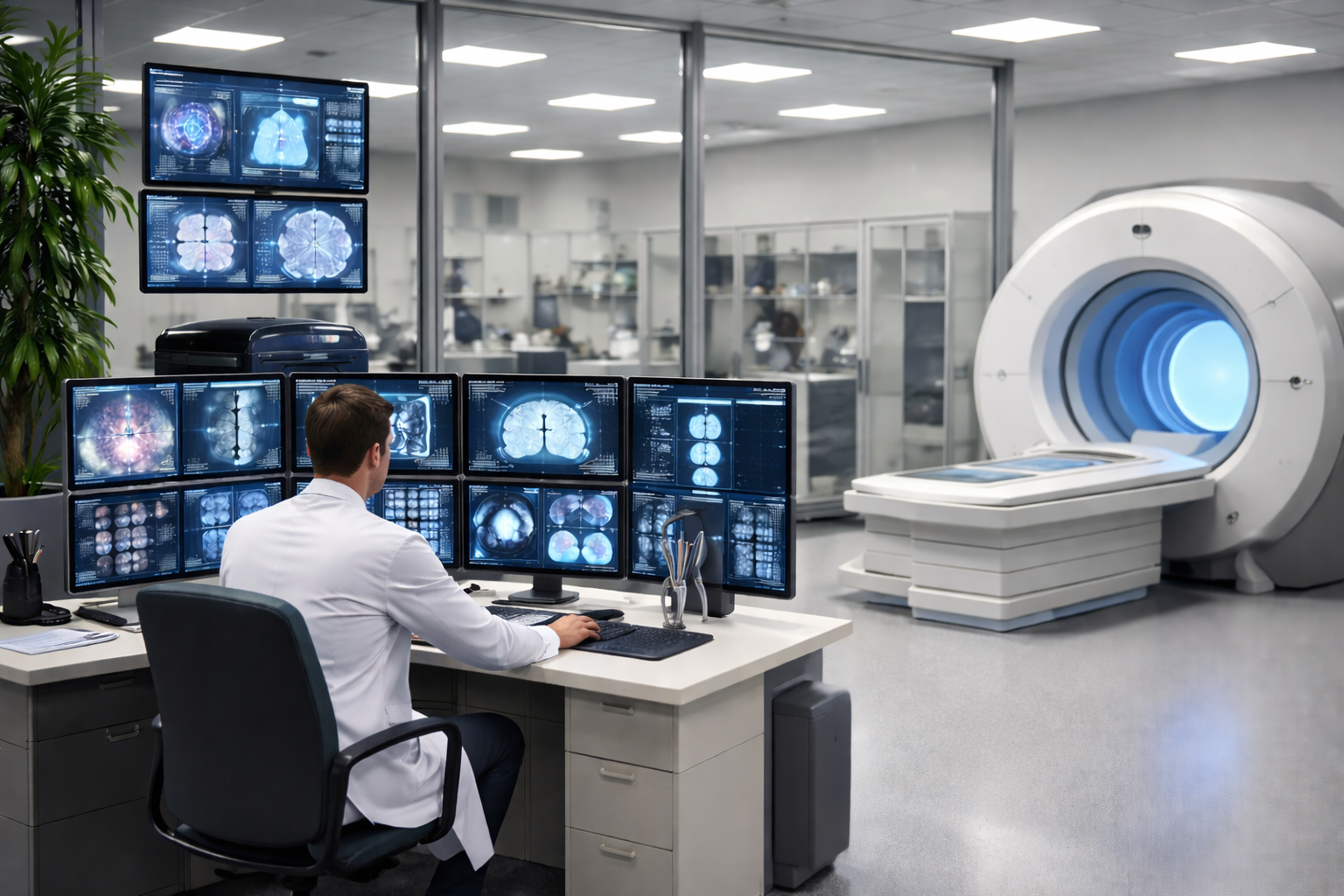
PACS in 2026: From Image Storage to the Intelligence Layer of Radiology
Introduction: Why “Basic PACS” Is No Longer Enough
By 2026, radiology is no longer measured only by how fast images are captured or reports are delivered. The real differentiator is how intelligently imaging data is used across the clinical continuum.
Most hospitals already “have a PACS.” But many are running systems designed for a different era—when storage was the primary goal. Today, imaging volumes are exploding, subspecialty reporting is fragmented, AI tools are entering daily workflows, and clinicians expect instant, contextual access to images from anywhere.
Modern PACS is no longer just infrastructure. It has become the operational and intelligence backbone of radiology.
PACS Redefined: What It Really Means in 2026
In 2026, PACS is best understood as a clinical imaging platform, not a repository. Its role now includes:
- Orchestrating imaging workflows end to end
- Enabling distributed and subspecialty reporting
- Acting as the integration hub for AI, RIS, HIS, and EMR
- Delivering imaging intelligence at the point of care
A PACS that only stores DICOM images is functionally obsolete.
Key Industry Shifts Shaping PACS in 2026
1. Imaging Volume Growth Without Proportional Staff Growth
Radiology departments are handling 30–50% higher study volumes compared to a few years ago, while radiologist availability has not scaled at the same rate.
Modern PACS addresses this imbalance by:
- Intelligent worklist prioritization
- Automated study routing by modality, urgency, or subspecialty
- Load balancing across sites and radiologists
Efficiency is no longer optional—it is existential.
2. PACS as the Foundation for Teleradiology and Distributed Care
Hybrid and fully remote radiology models are now standard. PACS must natively support:
- Zero-footprint web viewers with diagnostic fidelity
- Secure access across geographies and time zones
- Consistent performance regardless of location
Departments relying on VPN-heavy or workstation-bound PACS struggle with latency, downtime, and clinician frustration.
3. Cloud-Native PACS Is Becoming the Default Architecture
The conversation has shifted from “Should we move to the cloud?” to “Why are we still maintaining on-prem PACS?”
Cloud-native PACS enables:
- Elastic scaling during peak workloads
- Built-in disaster recovery and high availability
- Faster deployment of updates and new features
- Lower long-term total cost of ownership
Importantly, leading institutions are adopting hybrid models, keeping latency-sensitive functions local while leveraging the cloud for storage, analytics, and collaboration.
4. PACS + AI: From Pilot Projects to Daily Practice
AI in radiology has moved beyond experimentation. In 2026, PACS is the delivery mechanism for AI, not a separate system.
Advanced PACS platforms now:
- Embed AI results directly into the viewer
- Automatically flag critical findings
- Compare current studies with priors using algorithms
- Reduce cognitive load for radiologists
Without PACS-level AI integration, even the best algorithms fail to create clinical impact.
5. Interoperability Is a Clinical Requirement, Not an IT Feature
Radiologists and clinicians expect imaging to be:
- Instantly accessible within EMR workflows
- Contextualized with reports, labs, and clinical history
- Shareable across departments and external partners
Modern PACS prioritizes:
- Standards-based interoperability (DICOM, HL7, FHIR)
- Vendor-neutral strategies to avoid data silos
- Seamless RIS, HIS, and EMR integration
Disconnected systems are now a direct threat to patient safety and clinician adoption.
6. Data Governance, Security, and Trust
As imaging data becomes more accessible, governance becomes more critical. PACS in 2026 must support:
- Granular role-based access
- Comprehensive audit trails
- Encryption at rest and in transit
- Compliance with evolving data protection regulations
Security is no longer just about preventing breaches—it’s about enabling safe access at scale.
7. PACS as a Source of Operational Intelligence
Leading radiology departments now use PACS data to answer strategic questions:
- Where are reporting bottlenecks occurring?
- Which modalities are under- or over-utilized?
- How can turnaround times be reduced without burnout?
Modern PACS platforms provide analytics that turn imaging operations into measurable, optimizable processes.
What Forward-Looking Radiology Departments Expect from PACS
In 2026, decision-makers evaluate PACS based on:
- Workflow intelligence, not just features
- Cloud readiness and scalability
- AI integration roadmap
- Ease of use for radiologists and clinicians
- Long-term adaptability, not short-term cost
PACS selection has become a strategic decision, not a procurement exercise.
Final Perspective: PACS as Strategic Infrastructure
PACS is no longer a background system quietly storing images. It is now:
- A productivity engine for radiologists
- A collaboration platform for clinicians
- A launchpad for AI-driven diagnostics
- A critical pillar of digital healthcare strategy
Radiology departments that modernize their PACS are not merely upgrading technology—they are redefining how imaging contributes to clinical outcomes and organizational resilience.
In 2026, the question is no longer “Do we need PACS?”
It is “Is our PACS capable of supporting where radiology is going next?”