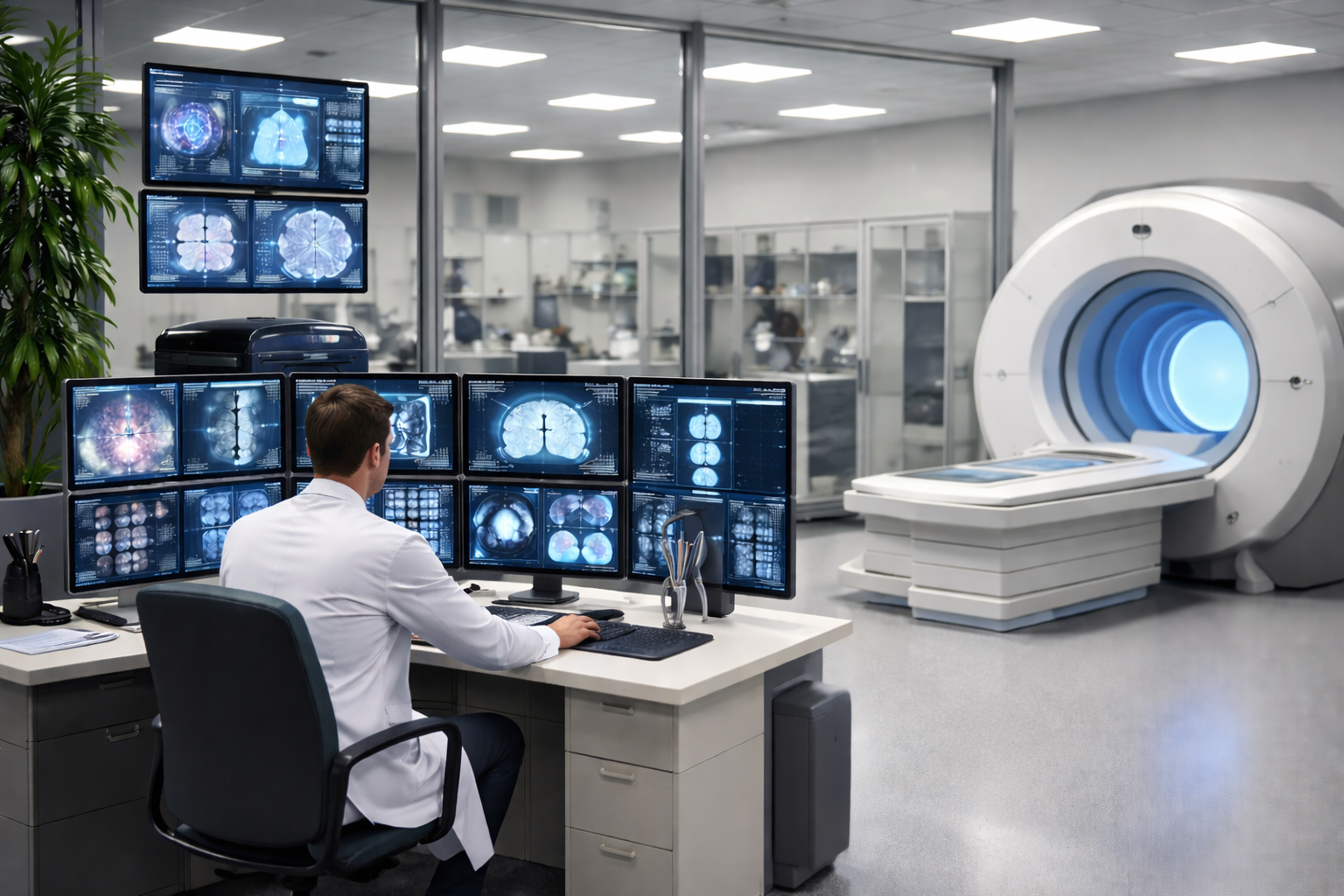
How Modern PACS Reduces Radiology Turnaround Time and Elevates Diagnostic Accuracy
In today’s outcome-driven healthcare environment, time is still brain — but now intelligence is accuracy.
Radiology workflows no longer depend solely on image availability; they depend on how fast insights are generated and acted upon.
Modern PACS has evolved far beyond image storage. Powered by AI, cloud infrastructure, and deep system integration, today’s PACS actively accelerates reporting, reduces cognitive load, and improves diagnostic confidence.
Let’s break down how next-generation PACS delivers speed and precision.
1. Faster Turnaround Time Through Intelligent Workflow Automation
Traditional PACS removed films. Modern PACS removes friction.
AI-Driven Case Prioritization
Instead of static worklists, AI algorithms now:
- Auto-flag critical findings (stroke, hemorrhage, pneumothorax)
- Push urgent studies to the top of the radiologist’s queue
- Reduce time-to-first-read in emergency settings
This ensures that life-threatening cases are never buried in routine exams.
Zero-Latency Image Access (Cloud + Edge)
Cloud-enabled PACS allows:
- Instant access from anywhere (hospital, home, mobile)
- No delays caused by local server bottlenecks
- Faster load times even for large CT/MRI datasets
Radiologists can read studies the moment acquisition completes.
Smart Integration with RIS, HIS, and EMR
Modern PACS uses bi-directional integration to:
- Auto-populate patient history and clinical notes
- Eliminate duplicate data entry
- Trigger automated reporting workflows
The result: minutes shaved off every case — hours saved per day.
2. Diagnostic Accuracy Powered by AI and Advanced Visualization
Speed only matters when accuracy keeps pace. Today’s PACS doesn’t just display images — it assists interpretation.
AI-Assisted Detection and Quantification
AI tools embedded within PACS can:
- Detect subtle lesions that the human eye may miss
- Quantify tumor volume, lung nodules, or bone density
- Track disease progression objectively over time
Radiologists remain in control — AI acts as a second reader, not a replacement.
Advanced Image Processing Beyond Film Capabilities
Modern PACS enables:
- Adaptive windowing and contrast presets
- Automated measurements and annotations
- 3D, MPR, and volumetric reconstructions
These tools significantly improve interpretation of:
- Complex fractures
- Neuro and vascular studies
- Oncology imaging
3. Longitudinal Intelligence: Seeing Change, Not Just Images
Diagnostic accuracy often lies in trend analysis, not a single scan.
Intelligent Prior Study Comparison
Modern PACS:
- Automatically pulls relevant historical studies
- Aligns images spatially and temporally
- Highlights measurable changes over time
This is critical for:
- Oncology follow-ups
- Chronic disease monitoring
- Post-operative assessment
Radiologists move from “Is this new?” to “How fast is this changing?”
4. Collaborative Diagnostics and AI-Enabled Teleradiology
Radiology is no longer confined to one reading room.
Real-Time Collaboration
Modern PACS allows:
- Simultaneous viewing by multiple clinicians
- Live annotations and discussion
- Faster consensus on complex cases
AI-Enhanced Teleradiology
With AI pre-screening:
- Routine studies can be filtered
- Specialists focus on complex cases
- Rural and underserved centers gain access to subspecialty expertise
This ensures diagnostic equity without compromising quality.
5. Reducing Human Error Through Intelligent Data Governance
Human error often originates outside image interpretation.
Modern PACS minimizes this risk by:
- Enforcing DICOM and HL7 standards
- Automating patient-image matching
- Maintaining immutable audit trails
AI further assists by:
- Detecting protocol mismatches
- Flagging incomplete studies
- Reducing reporting inconsistencies
Less administrative noise = more diagnostic focus.
The Bottom Line: PACS Has Become a Clinical Intelligence Platform
Today’s PACS is no longer just about speed or storage.
It is about decision support, accuracy at scale, and sustainable radiology operations.
By combining:
- AI-driven prioritization
- Cloud-based accessibility
- Advanced visualization
- Collaborative intelligence
Modern PACS helps healthcare organizations:
- Reduce turnaround times dramatically
- Improve diagnostic confidence
- Deliver better outcomes with fewer errors
This isn’t an upgrade — it’s a transformation of radiology itself.