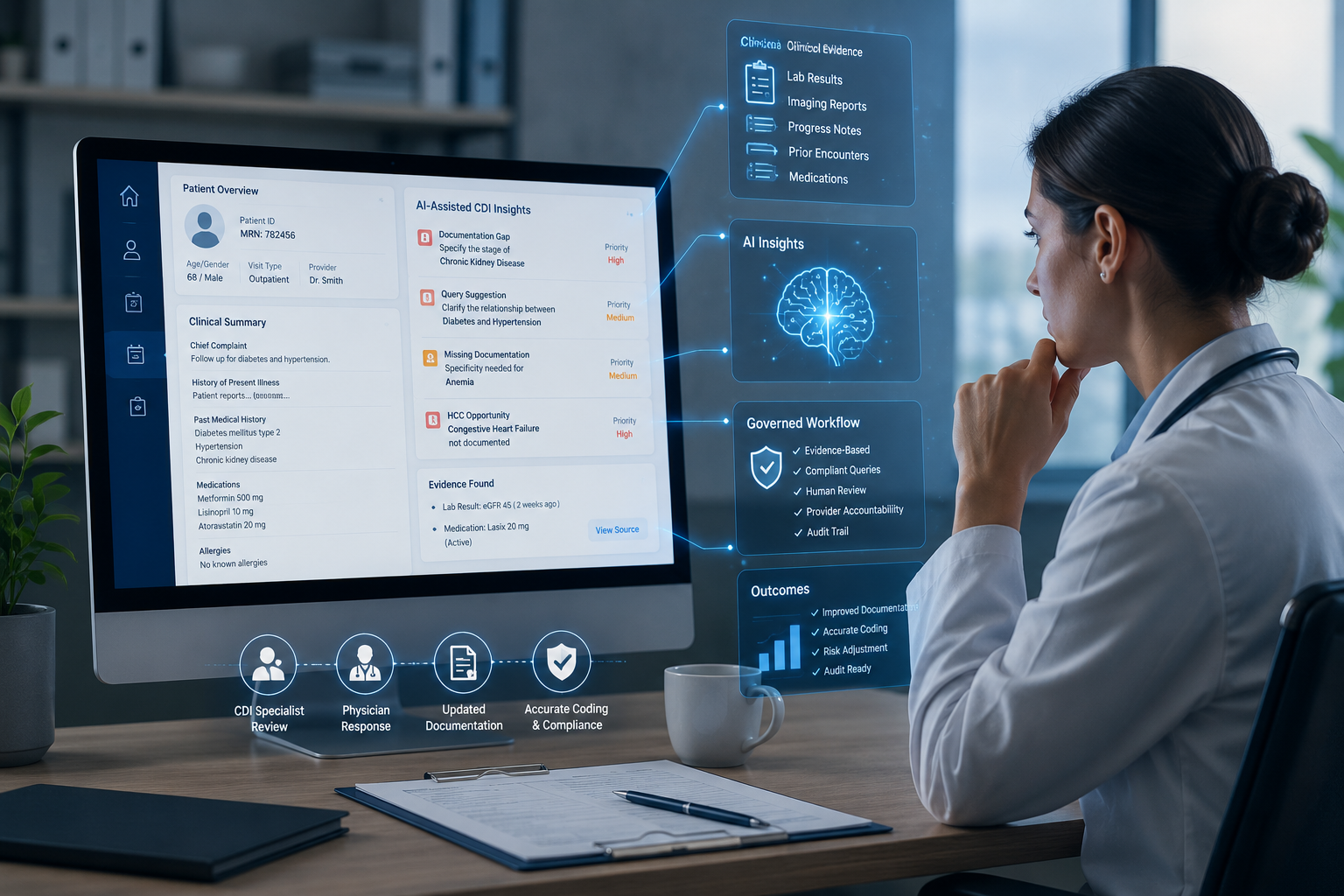
AI in CDI Needs Governance, Not Blind Automation
AI Is Changing CDI, But Speed Alone Is Not the Goal
Artificial intelligence is rapidly entering clinical documentation integrity, medical coding, revenue cycle management, physician documentation, risk adjustment, and health information management workflows.
For CDI leaders, the opportunity is significant.
AI can help review charts faster, identify documentation gaps earlier, prioritize high-risk cases, surface clinical evidence, and reduce the manual burden on CDI specialists, coders, physicians, and revenue-cycle teams.
But there is also a serious risk.
AI can scale documentation ambiguity just as fast as it scales productivity.
That is the central challenge for healthcare organizations adopting AI-enabled CDI tools. The goal should not be to generate more queries, more coding suggestions, more diagnosis prompts, or more automated alerts. The goal should be to improve the accuracy, completeness, compliance, and defensibility of the clinical record.
In other words, the future of AI in CDI is not blind automation.
The future is governed intelligence.
What Is AI-Enabled CDI?
AI-enabled CDI refers to the use of artificial intelligence, machine learning, natural language processing, large language models, and advanced analytics to support clinical documentation integrity workflows.
These tools may help CDI teams:
- Identify missing or unclear diagnoses.
- Detect documentation gaps.
- Suggest potential HCCs, CCs, or MCCs.
- Prioritize charts for review.
- Support outpatient CDI and risk adjustment workflows.
- Analyze provider documentation patterns.
- Flag potential clinical validation concerns.
- Support coding accuracy.
- Improve revenue-cycle efficiency.
- Reduce administrative workload.
Used appropriately, AI can be a powerful CDI productivity and quality tool.
Used poorly, it can become a compliance problem.
That is because CDI is not simply a data extraction exercise. CDI requires clinical reasoning, coding knowledge, regulatory awareness, compliant communication, physician engagement, and an understanding of the patient’s complete clinical story.
AI can assist that process.
It should not replace it.
The Problem With Blind CDI Automation
Blind automation occurs when healthcare organizations allow AI tools to generate documentation suggestions, diagnosis prompts, or physician queries without sufficient governance, evidence review, or human accountability.
In CDI, that is dangerous.
A diagnosis should not be suggested simply because an algorithm finds a keyword.
A physician query should not be generated simply because a model predicts a coding opportunity.
An HCC should not be captured simply because it appears in a prior note or problem list.
A CC or MCC should not be treated as valid unless the clinical evidence supports the condition and the provider documentation accurately reflects the patient’s status.
The danger is not that AI makes CDI faster.
The danger is that AI can make weak CDI faster.
- That can lead to:
- Unsupported diagnoses.
- Over-querying providers.
- Leading or non-compliant queries.
- Inaccurate final-coded claims.
- HCC capture without clinical validation.
- Increased audit exposure.
- Higher denial risk.
- Provider distrust.
- Compliance concerns.
- Polluted clinical data.
- Inaccurate quality and risk reporting.
If AI accelerates these problems, the organization may not discover the damage until months or years later through payer audits, risk adjustment reviews, clinical validation denials, quality reporting discrepancies, or compliance investigations.
CDI Is About Documentation Integrity, Not Query Volume
One of the biggest mistakes health systems can make is measuring AI-enabled CDI success by query volume alone.
More queries do not necessarily mean better documentation.
More alerts do not necessarily mean better CDI performance.
More suspected diagnoses do not necessarily mean better risk adjustment.
A strong CDI program should focus on the quality, relevance, compliance, and clinical defensibility of documentation interventions.
Better metrics include:
- Percentage of queries supported by clear clinical evidence.
- Provider response quality.
- Reduction in ambiguous documentation.
- Improvement in coding accuracy.
- Reduction in clinical validation denials.
- Improvement in HCC documentation specificity.
- Improvement in CC/MCC documentation accuracy.
- Reduction in retrospective coding conflicts.
- Audit outcomes.
- Provider trust and adoption.
- Evidence traceability from chart review to query to final documentation.
AI-enabled CDI should help teams ask better questions, not simply ask more questions.
Why Provider Accountability Still Matters
The physician or qualified provider owns the clinical story.
AI can summarize evidence, detect patterns, and recommend review opportunities. CDI specialists and coders can interpret documentation gaps and coding implications. But the provider is ultimately responsible for documenting the patient’s condition accurately.
That principle becomes even more important as AI becomes more sophisticated.
A polished AI-generated suggestion can look authoritative even when the underlying clinical evidence is incomplete or ambiguous. A documentation prompt may appear reasonable even when the diagnosis is not clinically supported. An automated query may seem efficient even when it risks leading the provider.
That is why provider accountability must remain central to AI-enabled CDI.
The best AI CDI workflows should preserve the provider’s role by:
- Presenting evidence clearly.
- Avoiding leading language.
- Showing why a documentation clarification may be needed.
- Allowing the provider to confirm, reject, or clarify.
- Making the final clinical judgment explicit.
- Maintaining an audit trail.
- Supporting education rather than pressure.
The goal is not to make physicians rubber-stamp AI suggestions.
The goal is to help physicians document the clinical truth more efficiently and accurately.
Outpatient CDI and HCC Risk Adjustment Need Special Governance
AI governance is especially important in outpatient CDI and HCC risk adjustment.
Risk adjustment programs depend on accurate documentation of chronic conditions, disease burden, complications, comorbidities, and clinical status. But diagnosis capture without clinical support can create serious compliance exposure.
For outpatient CDI, the right question is not merely:
“Can this condition be captured?”
The better question is:
“Is this condition current, clinically supported, documented by the provider, and defensible under audit?”
This is where AI can be helpful if designed correctly.
A governed AI-enabled outpatient CDI workflow can help identify:
- Chronic conditions that may need annual documentation.
- Conditions appearing in prior history but not assessed in the current encounter.
- Medication evidence that may suggest a condition requiring provider clarification.
- Lab or imaging results that may support further documentation review.
- Documentation inconsistencies between the problem list, assessment, plan, and orders.
- Potential HCC opportunities requiring clinical validation.
- Missing specificity in diagnosis documentation.
But AI should not convert these signals into final diagnosis capture without provider confirmation and evidence review.
In risk adjustment, defensibility matters as much as discovery.
What Good AI Governance in CDI Looks Like
A strong AI governance framework for CDI should include clinical, operational, compliance, technical, and revenue-cycle controls.
At minimum, healthcare organizations should define:
1. Clear Use Cases
AI should be deployed for specific CDI use cases, such as outpatient HCC review, inpatient CC/MCC documentation gaps, clinical validation support, query prioritization, or provider education.
Vague AI deployment creates vague accountability.
2. Evidence-Linked Recommendations
Every AI suggestion should be traceable to specific evidence in the medical record. CDI professionals should be able to see what triggered the recommendation and whether the evidence is clinically relevant.
No black-box diagnosis prompts.
3. Compliant Query Safeguards
AI-supported queries must follow compliant query practice. They should be non-leading, clinically supported, clearly written, and designed to clarify documentation rather than influence the provider toward a preferred financial outcome.
4. Human Review
AI should assist CDI specialists, coders, physicians, and HIM professionals. It should not bypass them.
Human review is essential for clinical interpretation, compliance judgment, and provider communication.
5. Provider Accountability
The provider must retain ownership of the final clinical documentation. AI should make the evidence easier to understand, not replace clinical judgment.
6. Audit Trails
AI-enabled CDI workflows should capture the reasoning path from source documentation to AI suggestion to CDI review to provider query to final documentation outcome.
This is essential for audit readiness.
7. Feedback Loops
Organizations should continuously review AI recommendations, false positives, provider responses, denial outcomes, coding results, and audit findings.
AI governance is not a one-time implementation task. It is an operating discipline.
8. Cross-Functional Oversight
AI in CDI should not be owned by one department alone.
Effective governance should include CDI, HIM, coding, compliance, medical staff leadership, quality, revenue cycle, IT, privacy, security, and clinical operations.
The Role of Clinical Data Management
AI-enabled CDI also depends on the quality of the underlying clinical data.
Many healthcare organizations still struggle with fragmented documentation across EHR notes, scanned documents, faxes, dictated reports, lab results, imaging reports, external records, prior authorizations, referral documents, discharge summaries, and patient-submitted files.
When clinical data is scattered, AI has an incomplete view of the patient.
That can create documentation gaps, missed evidence, duplicate work, and unreliable recommendations.
This is why clinical data management matters.
Before AI can support CDI effectively, organizations need a reliable way to capture, organize, normalize, retrieve, and govern clinical documentation across sources.
This is where a clinical data fabric becomes valuable.
A clinical data fabric helps connect documentation sources so that CDI, coding, quality, risk adjustment, and revenue-cycle teams can work from a more complete and trusted clinical record.
For Doc-U-Scribe, this creates a broader strategic role: not just transcription, but clinical data management.
For Doc-U-Aide, it creates a stronger CDI foundation: AI-assisted documentation review built on accessible, organized, and evidence-rich clinical data.
The Saince Perspective: Governed AI for Documentation Integrity
At Saince, our view is simple:
AI should make CDI more intelligent, not merely more automated. Doc-U-Aide is designed around the idea that outpatient CDI and documentation integrity require evidence, clinical validation, compliant workflows, and audit readiness.
The purpose of AI in CDI should be to help teams identify meaningful documentation opportunities, support accurate HCC and risk adjustment workflows, improve coding integrity, and strengthen the defensibility of the clinical record.
But AI should not become a shortcut around clinical judgment. AI should help CDI professionals and providers work better together. It should help organizations create documentation that is accurate, complete, timely, compliant, and clinically meaningful.
That is the difference between automation and integrity.
Why This Matters for Healthcare Leaders
For CFOs, AI-enabled CDI can improve revenue-cycle performance, reduce leakage, and support audit readiness.
For CMOs, it can improve documentation quality, provider alignment, and clinical accountability.
For compliance leaders, it can reduce the risk of unsupported diagnosis capture and non-compliant query practices.
For HIM leaders, it can strengthen coding accuracy, documentation governance, and clinical data quality.
For CDI leaders, it can elevate the CDI function from retrospective chart review to proactive documentation intelligence.
For CIOs, it creates a need for governed AI systems that are transparent, integrated, secure, and auditable.
For quality leaders, it supports more accurate data for measurement, reporting, benchmarking, and patient-risk analysis.
AI in CDI is not just a technology decision. It is a governance decision.
Conclusion: The Best CDI AI Will Be Evidence-Based, Governed, and Auditable
AI will change clinical documentation integrity.
But healthcare organizations should be careful about what they are optimizing for.
- If they optimize only for speed, they may create faster documentation noise.
- If they optimize only for query volume, they may create provider fatigue.
- If they optimize only for HCC capture, they may create audit exposure.
- If they optimize only for automation, they may weaken trust.
The better path is governed intelligence.
AI-enabled CDI should be evidence-linked, compliant, clinically reviewed, provider-accountable, auditable, and aligned with the organization’s documentation integrity strategy.
That is how healthcare organizations can use AI to strengthen clinical documentation rather than simply accelerate it. Because the ultimate goal of CDI is not more codes.
It is a more accurate clinical record. And in the AI era, that distinction matters more than ever.